
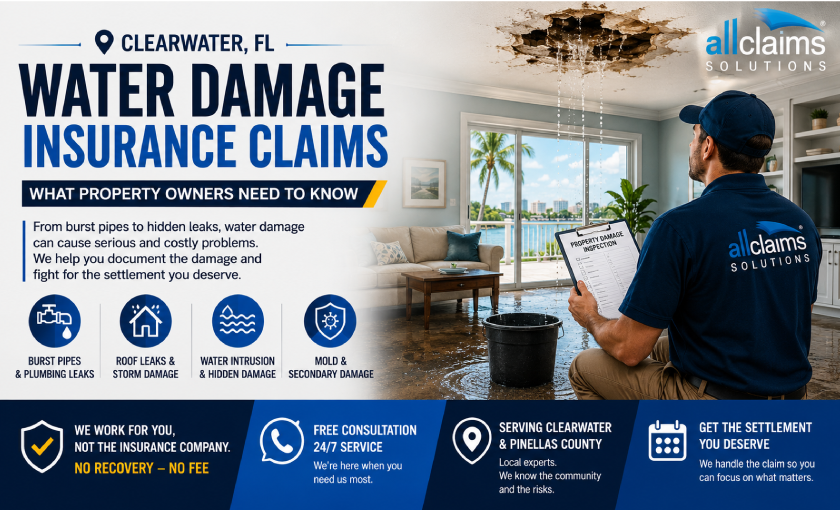
Water damage can happen suddenly and without warning. A burst pipe, plumbing leak, roof leak, appliance failure, storm, or other unexpected event can cause significant damage to a home or commercial property in Clearwater, FL.
What may begin as a small water leak can quickly develop into damaged flooring, ceilings, drywall, cabinets, insulation, electrical components, personal belongings, and even hidden moisture or mold.
For Clearwater property owners, understanding what caused the water damage, what insurance policy may apply, and how the loss is documented can be critical when filing an insurance claim.
At All Claims Solutions, our Public Adjusters help property owners throughout Clearwater and surrounding Pinellas County communities navigate the insurance claims process after property damage.
We work for you—not the insurance company.
What Is Considered Water Damage?
Water damage generally refers to property damage caused by water entering or escaping within a structure.
Common examples include:
- Burst pipes
- Plumbing leaks
- Supply line failures
- Washing machine leaks
- Dishwasher leaks
- Water heater failures
- Refrigerator or appliance leaks
- Roof leaks
- Storm-related water intrusion
- Toilet or bathroom leaks
- HVAC condensation or drainage problems
- Water entering through damaged windows or doors
The cause of the loss matters because insurance coverage depends on the specific policy, circumstances, exclusions, deductibles, and cause of damage.
Common Causes of Water Damage in Clearwater Properties
Clearwater property owners can experience water damage from many different sources.
1. Burst or Broken Pipes
A failed pipe can release a significant amount of water into a property in a very short period of time.
Water may spread into:
- Walls
- Ceilings
- Flooring
- Cabinets
- Bedrooms
- Bathrooms
- Electrical areas
- Adjacent rooms
The visible damage may represent only part of the actual loss.
2. Plumbing Leaks
A slow plumbing leak can sometimes be more difficult to identify than a major pipe break.
Water may accumulate behind:
- Walls
- Cabinets
- Bathroom fixtures
- Appliances
- Flooring
Over time, hidden moisture can contribute to deterioration and microbial growth.
3. Water Heater Damage
A failed water heater can release a large amount of water into a home or commercial property.
Damage may extend beyond the immediate area surrounding the appliance.
Flooring, drywall, baseboards, cabinets, and personal property can all potentially be affected.
4. Appliance Leaks
Common sources include:
- Washing machines
- Dishwashers
- Refrigerators
- Ice makers
- Water filtration systems
A failed supply line or appliance component can cause significant water damage before the problem is discovered.
5. Roof Leaks and Storm Damage
Water can also enter a property after roof damage caused by wind or severe weather.
For example:
Storm → Roof Damage → Rain Intrusion → Interior Water Damage
In these situations, understanding the relationship between the storm damage and resulting interior damage can be important when documenting the insurance claim.
Is Water Damage Covered by Homeowners Insurance in Clearwater?
This is one of the most common questions property owners ask.
The answer depends on the policy and the cause of the water damage.
Some sudden and accidental water losses may be covered, while other situations may be excluded or limited.
For example, policies may contain provisions relating to:
- Long-term leaks
- Maintenance issues
- Wear and tear
- Gradual deterioration
- Flooding
- Mold
- Negligence
- Certain plumbing failures
This is why property owners should avoid assuming that every water-related loss is either covered or excluded.
The insurance policy and the specific circumstances of the loss need to be evaluated.
Water Damage vs. Flood Damage: What’s the Difference?
This distinction is especially important in Clearwater.
Water damage and flood damage are not necessarily the same thing for insurance purposes.
Pinellas County states that most homeowners’ and renters’ insurance policies do not cover losses caused by flooding. Flood insurance is generally a separate form of coverage, and Pinellas County recommends considering flood insurance even when it is not required by a lender.
Water Damage
Depending on the circumstances and policy, water damage can result from events such as:
- Burst pipes
- Plumbing failures
- Appliance leaks
- Certain roof leaks
- Accidental water discharge
Flood Damage
Flood insurance generally addresses damage caused by flooding, including water from inland or tidal flooding.
Pinellas County notes that flooding can occur from heavy rainfall or tropical weather events and that everyone lives in a flood zone, although the level of risk varies.
Why This Matters
Consider two different scenarios:
Scenario A
A pipe suddenly bursts inside your home and releases water throughout the property.
Scenario B
Storm water or rising water enters the property from outside.
The insurance implications can be very different.
That’s why identifying the cause and source of the water is an important part of evaluating a claim.
What Should You Do After Water Damage?
Taking the right steps immediately after a water loss can help protect your property and create better documentation for your insurance claim.
Step 1: Stop the Source of Water When Safe
If possible, stop the source of the water.
This might involve:
- Turning off the water supply
- Shutting off an appliance
- Contacting a qualified plumber
- Addressing a broken pipe
Safety should always come first.
Step 2: Prevent Additional Damage
Property owners generally have a responsibility to take reasonable steps to mitigate additional damage.
Florida’s Department of Financial Services advises policyholders to take necessary steps to mitigate damage, including temporary measures such as covering a damaged roof or removing standing water.
Emergency mitigation may include:
- Removing standing water
- Drying affected areas
- Protecting undamaged property
- Covering openings
- Arranging emergency repairs
Keep records and receipts for work performed and expenses incurred.
Step 3: Document Everything
Before damaged materials are removed whenever reasonably possible, take detailed photographs and videos.
Document:
The Source
- Broken pipe
- Plumbing fixture
- Appliance
- Roof
- Water heater
- Other source of the loss
The Damage
- Walls
- Ceilings
- Flooring
- Cabinets
- Baseboards
- Doors
- Personal property
- Electrical components
The Affected Areas
Document both obvious and less visible areas of damage.
Pinellas County specifically recommends taking photographs or videos of flood damage before moving debris or removing damaged belongings.
Step 4: Keep Your Documentation
Create a dedicated folder for your claim.
Include:
- Photos
- Videos
- Receipts
- Plumbing invoices
- Mitigation invoices
- Contractor estimates
- Inspection reports
- Insurance correspondence
- Claim number
- Policy information
- Inventory of damaged belongings
Good documentation can help establish the scope and circumstances of the loss.
Hidden Water Damage: Why It Matters
One of the biggest challenges with water damage is that not everything can be seen immediately.
Water can travel behind:
- Drywall
- Cabinets
- Flooring
- Baseboards
- Insulation
- Walls
- Ceilings
A room may appear relatively normal while moisture remains inside building materials.
This can lead to additional problems if the affected areas are not properly identified and addressed.
Water Damage and Mold
Mold can become a concern when moisture remains inside a property.
The important question for an insurance claim is not simply:
“Is there mold?”
The more important questions may include:
- What caused the moisture?
- When did the water damage occur?
- Was the moisture properly documented?
- What areas were affected?
- What remediation is necessary?
- What does the policy provide?
Because mold coverage can vary significantly by policy and circumstances, property owners should review the applicable policy rather than assume that mold is automatically covered or excluded.
What If the Insurance Company Says the Damage Is Not Covered?
A water damage claim can sometimes become disputed over the cause of loss.
For example, an insurer may argue that damage resulted from:
- Long-term seepage
- Wear and tear
- Lack of maintenance
- An excluded cause
- Flooding
- Pre-existing damage
The property owner may have a different understanding of what happened.
When coverage or causation is disputed, documentation becomes particularly important.
A licensed Public Adjuster can help evaluate the property damage and prepare documentation supporting the policyholder’s position.
What If the Insurance Estimate Is Too Low?
Another common problem is receiving an estimate that does not appear to reflect the full scope of the damage.
The estimate may not include everything affected by the water loss.
For example:
Initial visible damage
↓
Drywall
↓
Flooring
↓
Cabinets
But further inspection may reveal:
Hidden moisture
Insulation damage
Additional flooring damage
Baseboard damage
Structural components
Additional repair requirements
A proper claim evaluation should consider the documented scope of the loss rather than focusing only on the most visible damage.
Can You File a Supplemental Water Damage Claim?
In some circumstances, additional damage or costs may be addressed through a supplemental claim.
Florida law currently provides that a supplemental property insurance claim generally must be reported within 18 months after the date of loss, while a claim or reopened claim generally must be reported within one year, subject to the statute, policy requirements, and applicable circumstances.
For that reason, property owners should avoid waiting until a deadline approaches.
If additional damage is discovered while repairs are underway, discuss the situation with the appropriate insurance and claims professionals as soon as possible.
Common Water Damage Insurance Claim Mistakes
1. Waiting Too Long to Report the Damage
Don’t assume a small leak will remain a small problem.
Water damage can worsen over time.
2. Cleaning Everything Before Documenting It
Whenever reasonably possible, document the condition of the property before removing damaged materials.
3. Throwing Away Damaged Property Without Documentation
If damaged belongings need to be discarded, photograph and document them first whenever possible.
4. Focusing Only on Visible Damage
Hidden moisture can create additional problems.
5. Assuming Water Damage Automatically Means Flood Damage
The source and cause of the water matter.
6. Accepting an Estimate Without Reviewing the Scope
An estimate should be evaluated against the actual documented damage.
7. Signing Documents Without Understanding Them
Pinellas County advises property owners not to sign an Assignment of Benefits as a condition of receiving repairs, and Florida’s Department of Financial Services notes that post-loss assignment rules changed for residential and commercial property insurance contracts issued or renewed on or after January 1, 2023.
Water Damage Insurance Claims for Clearwater Condos
Clearwater has a significant condominium and multi-unit property market.
Water damage in a condo can be more complicated because a single loss may affect:
- An individual unit
- Adjacent units
- Common areas
- Building systems
- Association property
- Personal belongings
For example, a pipe failure in one unit could cause water damage to another unit or to shared building components.
Determining which policy may respond to which portion of the loss can become an important part of the claim process.
Water Damage Insurance Claims for Clearwater Businesses
Water damage can be particularly disruptive for commercial properties.
Businesses may face:
- Building damage
- Equipment damage
- Inventory loss
- Interior damage
- Temporary closure
- Relocation expenses
- Loss of income
- Business interruption
For a business owner, the financial impact may continue even after the physical damage has been repaired.
Commercial property owners should therefore consider whether the insurance policy includes applicable business interruption or loss of income coverage.
Water Damage in Clearwater Beach and Coastal Properties
Clearwater’s coastal environment creates additional considerations for property owners.
Properties in and around:
- Clearwater Beach
- Sand Key
- Island Estates
- Downtown Clearwater
- Belleair
- Largo
- Dunedin
- Safety Harbor
can experience different combinations of storm-related water intrusion, flooding, plumbing problems, and other property damage.
Pinellas County emphasizes that flooding can occur throughout the county, not only immediately adjacent to the coast, and recommends that property owners understand both their flood risk and evacuation zone.
For coastal property owners, understanding the difference between water damage, storm-related water intrusion, and flood damage is particularly important.
How a Public Adjuster Can Help With a Water Damage Claim
A Public Adjuster represents the policyholder during the property insurance claims process.
For a complex water damage claim, a Public Adjuster may assist with:
Property Inspection
Evaluating visible and potentially hidden damage.
Documentation
Organizing photographs, measurements, estimates, reports, and other supporting documentation.
Policy Review
Reviewing the applicable insurance policy to understand relevant coverage and limitations.
Claim Preparation
Helping document and present the scope of the property loss.
Insurance Company Communication
Assisting with claim-related communications.
Negotiation
Representing the policyholder during discussions regarding the documented loss and applicable coverage.
Why Clearwater Property Owners Choose All Claims Solutions
When water damage affects your property, the claims process can feel overwhelming.
At All Claims Solutions, our goal is to make the process easier to understand and help property owners properly document their losses.
Our process focuses on:
Inspect
→ Document
→ Review
→ Prepare
→ Present
→ Negotiate
We work with property owners throughout Clearwater and surrounding Pinellas County communities.
We Work for You—not the Insurance Company.
No Recovery – No Fee.
Frequently Asked Questions About Water Damage Insurance Claims in Clearwater
It depends on the cause of the water damage and the terms of the specific insurance policy. Sudden and accidental water losses may be treated differently from flooding, long-term leaks, wear and tear, or other excluded causes.
Generally, standard homeowners insurance does not cover flood damage. Pinellas County recommends considering separate flood insurance because flooding can occur throughout the county.
Coverage depends on the circumstances and policy. A sudden pipe failure may be treated differently from damage caused by long-term deterioration or lack of maintenance.
Mold coverage varies by policy and circumstances. The cause of the moisture and the applicable policy provisions are important.
Under current Florida law, a property insurance claim or reopened claim generally must be reported within one year after the date of loss, while a supplemental claim generally must be reported within 18 months, subject to applicable requirements and policy terms.
Review the denial, the policy provisions cited by the insurer, and the documentation supporting the loss. A licensed Public Adjuster may be able to help evaluate the property damage and claim documentation.
Yes. A Public Adjuster represents the policyholder and can assist with inspection, documentation, claim preparation, communication, and negotiation.
Get Help With a Water Damage Insurance Claim in Clearwater, FL
Water damage can become much more complicated than it initially appears.
A single leak can lead to:
Water Damage → Hidden Moisture → Damaged Materials → Mold → Additional Repairs
And determining what happened, what was damaged, and what may be covered can be challenging.
If your home, condo, rental property, or business has suffered water damage, All Claims Solutions can help you understand and navigate the insurance claims process.
Don’t navigate a complicated property damage claim alone.
All Claims Solutions – Clearwater Public Adjusters
We Work for You—not the Insurance Company.
No Recovery – No Fee.
24/7 Service
This article is provided for general informational purposes and does not constitute legal advice or a determination of insurance coverage. Coverage depends on the specific insurance policy and circumstances of each loss.






[…] Need to Know Roof Damage Insurance Claims in Clearwater, FL: What Homeowners Need to Know Water Damage Insurance Claims in Clearwater, FL: What Property Owners Need to Know […]
[…] Hurricane Damage Insurance Claims in Clearwater, FL: What Property Owners Need to Know Roof Damage Insurance Claims in Clearwater, FL: What Homeowners Need to Know Water Damage Insurance Claims in Clearwater, FL: What Property Owners Need to Know […]
[…] Hurricane Damage Insurance Claims in Clearwater, FL: What Property Owners Need to Know Roof Damage Insurance Claims in Clearwater, FL: What Homeowners Need to Know Water Damage Insurance Claims in Clearwater, FL: What Property Owners Need to Know […]
[…] Related: [Water Damage Insurance Claims in Clearwater, FL] […]