
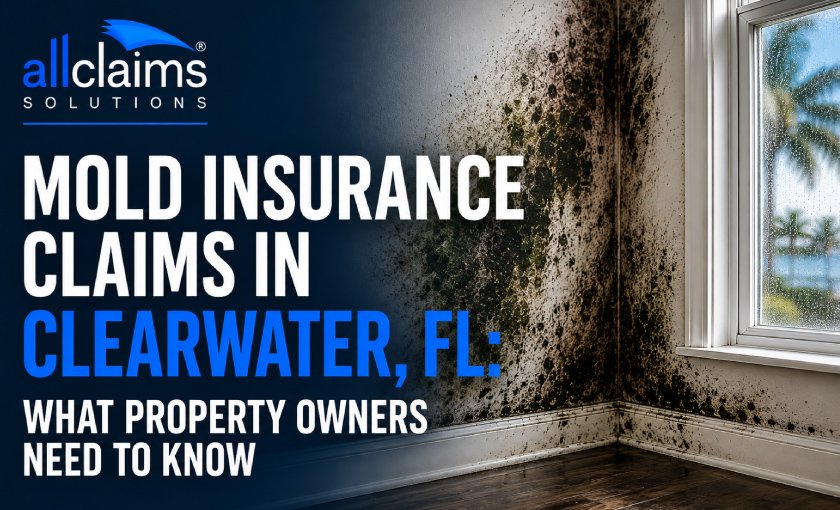
Mold can develop quickly after water enters your home or business.
A leaking roof, burst pipe, plumbing failure, storm damage, or other source of moisture can create conditions where mold grows behind walls, under flooring, inside cabinets, or in other hidden areas.
For property owners in Clearwater, FL, discovering mold often leads to an important question:
Does insurance cover mold damage?
The answer depends on what caused the mold, whether that cause of loss is covered by the policy, what exclusions or limits apply, and whether your policy includes additional mold coverage.
Florida’s Department of Financial Services explains that mold resulting from a covered peril is typically covered under a homeowners policy, although insurers commonly limit mold-related coverage and some policies may exclude mold altogether.
For example, a sudden and accidental water discharge from a burst pipe may potentially lead to covered mold damage, subject to the specific policy terms and limits.
At All Claims Solutions, our Public Adjusters help property owners throughout Clearwater and surrounding Pinellas County communities document property damage and navigate the insurance claims process.
We Work for You—not the Insurance Company.
What Causes Mold Damage in Clearwater, FL?
Mold requires moisture to grow.
In Clearwater, property owners may encounter moisture problems following:
- Plumbing leaks
- Burst pipes
- Water heater failures
- Roof leaks
- Storm damage
- Hurricane damage
- Wind-driven rain
- Appliance leaks
- HVAC leaks
- Water intrusion
- Flooding
- Long-term moisture problems
The source of the moisture is extremely important when evaluating a mold insurance claim.
For example:
Burst Pipe → Water Damage → Moisture → Mold
can present a very different insurance situation from:
Long-Term Leak → Moisture → Mold
The insurance company may examine whether the original cause was sudden and accidental, gradual, excluded, or related to maintenance.
Is Mold Covered by Homeowners Insurance in Florida?
Mold may be covered—but it is not automatically covered in every situation.
The Florida Department of Financial Services states that mold resulting from a covered peril is typically covered under a homeowners policy, although the amount of coverage can be limited.
The same guidance explains that insurers commonly limit mold-related coverage, with $10,000 being a common limit, while some policies may provide higher limits through endorsements and others may exclude mold-related claims.
This means property owners should avoid assuming either:
“My insurance always covers mold.”
or:
“Insurance never covers mold.”
The better question is:
What caused the mold, and what does my policy say about that cause and the resulting damage?
When Mold Damage May Be Covered
Mold may potentially be covered when it develops because of a covered cause of loss.
For example:
A Burst Pipe
A pipe suddenly breaks inside your Clearwater property.
Water spreads through the structure.
Building materials become wet.
Mold develops.
The claim may involve:
Burst Pipe → Water Damage → Mold
The Florida Department of Financial Services specifically identifies a sudden and accidental discharge of water from a burst pipe as an example of a covered peril that can result in mold coverage, although policy limits and exclusions still apply.
When Mold Coverage May Be Limited or Excluded
Mold claims can become more complicated when the underlying moisture problem involves:
- Long-term leaks
- Gradual seepage
- Wear and tear
- Deterioration
- Lack of maintenance
- Repeated water intrusion
- Pre-existing conditions
- Certain types of flooding
- Other excluded causes of loss
For example:
Small leak → leak continues for months → hidden moisture → mold
may be treated differently than:
Sudden pipe failure → immediate water damage → mold
The exact policy language and circumstances matter.
Does Insurance Cover Mold After Water Damage?
This is one of the most important questions for Clearwater property owners.
Consider this scenario:
A pipe suddenly breaks.
Water damages the flooring and drywall.
Some moisture remains inside the walls.
Mold develops several days or weeks later.
The claim may potentially involve multiple components:
1. The Original Water Loss
The plumbing failure.
2. Resulting Property Damage
Damage to walls, ceilings, flooring, cabinets, etc.
3. Mold Damage
Mold resulting from the moisture created by the original event.
The Florida Department of Financial Services notes that mold resulting from a covered peril may be covered, subject to the policy’s applicable limits and provisions.
This is why documenting the original water damage can be just as important as documenting the mold itself.
Mold After Roof Damage in Clearwater
Roof damage is another common pathway to mold.
A storm can damage roofing materials and create an opening.
Rain enters the property.
Moisture reaches:
- Attic insulation
- Drywall
- Ceilings
- Walls
- Flooring
- Cabinets
If those materials remain wet, mold may eventually develop.
The claim could therefore involve:
Storm Damage
↓
Roof Damage
↓
Water Intrusion
↓
Interior Damage
↓
Mold
Whether these damages are covered depends on the specific policy and circumstances of the loss.
This makes mold particularly relevant to Clearwater homeowners dealing with roof damage or storm insurance claims.
Mold After Hurricane Damage
Clearwater and Pinellas County properties can experience significant water intrusion during severe weather.
A hurricane or tropical storm may cause:
- Roof damage
- Wind damage
- Broken windows
- Damaged doors
- Water intrusion
- Interior moisture
- Structural damage
- Mold growth
Mold may not become visible immediately.
A property owner may initially notice only:
- A ceiling stain
- A musty smell
- Peeling paint
- Swollen flooring
- Discoloration
- Damp drywall
The underlying moisture may be much more extensive.
Can Flooding Cause Mold?
Yes.
Floodwater can introduce significant moisture into a property, creating conditions favorable to mold growth.
However, flood damage and mold damage should not automatically be treated as the same insurance issue.
Standard homeowners policies generally have different treatment for flood losses, and flood insurance has its own coverage provisions.
If mold develops after flooding, the applicable policy and cause of the water intrusion should be carefully reviewed.
This distinction is particularly important after major storms.
How Much Mold Damage Will Insurance Cover?
There is no single amount that applies to every Clearwater property.
Mold coverage can depend on:
- Policy limits
- Mold sublimits
- Deductibles
- Endorsements
- Exclusions
- Testing provisions
- Remediation provisions
- The cause of the loss
Florida’s Department of Financial Services states that mold-related coverage is commonly limited and notes that some insurers offer endorsements increasing mold coverage to $25,000 or $50,000, depending on the policy.
The important point is:
Don’t assume a standard mold limit applies to your policy.
Review the actual policy and endorsements associated with your property.
Mold Can Be Hidden Behind Walls
One of the biggest challenges with mold damage is that what you can see may not represent the full extent of the problem.
Mold and moisture can hide:
- Behind drywall
- Under flooring
- Behind cabinets
- Behind appliances
- Inside walls
- In attics
- Around HVAC systems
- Inside insulation
- Under carpets
Florida’s Department of Financial Services specifically warns that mold can hide behind walls, under carpet, and behind appliances and recommends professional assessment and remediation when necessary.
A small visible area can therefore be an indication of a larger moisture problem.
Signs of Mold or Hidden Moisture
Clearwater property owners should pay attention to:
Musty Odors
A persistent musty smell can indicate hidden moisture or mold.
Water Stains
Brown, yellow, or discolored areas on ceilings and walls may indicate previous or ongoing water intrusion.
Peeling Paint
Moisture behind walls can cause paint to bubble or peel.
Swollen Materials
Flooring, baseboards, cabinets, and drywall can swell after prolonged exposure to moisture.
Visible Mold
Mold can appear as dark, green, gray, white, or discolored patches.
Recurring Moisture
Repeated leaks or condensation can create conditions where mold continues to develop.
What Should You Do If You Discover Mold?
If you discover mold after property damage, don’t simply clean the visible area and assume the problem is resolved.
1. Identify the Source of Moisture
Determine whether the moisture came from:
- Plumbing
- Roof damage
- Storm damage
- HVAC
- Appliance failure
- Flooding
- Another source
2. Document the Property
Take photographs and videos of:
- Mold
- Water stains
- Wet materials
- Damaged drywall
- Flooring
- Ceilings
- Cabinets
- Roof damage
- Plumbing damage
- Personal property
Whenever reasonably possible, document the condition before major remediation or repairs alter the evidence.
3. Stop or Control the Source
If it is safe to do so, take reasonable steps to stop the source of moisture and prevent additional damage.
Keep documentation of emergency services and temporary repairs.
4. Notify Your Insurance Company
Follow your policy’s reporting requirements.
Keep records of:
- Claim number
- Date of loss
- Insurance adjuster
- Inspections
- Communications
- Estimates
- Reports
- Receipts
Florida’s Department of Financial Services provides consumer guidance on the homeowners insurance claim process and policyholder rights and responsibilities.
Should You Test for Mold?
The appropriate approach depends on the circumstances.
If there is visible mold or evidence of significant moisture, a qualified professional may be needed to evaluate the property and determine the appropriate remediation approach.
Testing and remediation are not necessarily the same thing.
A professional assessment may help determine:
- Where moisture is present
- Whether mold is present
- The extent of affected materials
- Which areas require remediation
- Whether additional investigation is needed
Florida also regulates mold assessment and remediation professionals under Chapter 468, including insurance requirements for licensed mold assessors and remediators.
What If the Insurance Company Says Mold Isn’t Covered?
This is where understanding the cause of loss becomes critical.
An insurer may argue that mold resulted from:
- An excluded cause
- Long-term moisture
- Wear and tear
- Lack of maintenance
- Flooding
- Pre-existing conditions
- Another policy exclusion
If that happens, review:
The Policy
Look at the applicable coverage, exclusions, limitations, and endorsements.
The Cause of Loss
Determine what actually caused the moisture.
The Timeline
Document when the original loss occurred and when mold was discovered.
The Physical Evidence
Photographs, videos, reports, estimates, and inspection documentation can help establish the circumstances of the loss.
Mold Is Often a Symptom of a Larger Property Damage Claim
This is one of the most important concepts for property owners.
Mold may not be the original problem.
Consider:
Storm Damage
↓
Roof Damage
↓
Water Intrusion
↓
Wet Building Materials
↓
Mold
Or:
Plumbing Failure
↓
Water Damage
↓
Hidden Moisture
↓
Mold
If a claim is evaluated only as:
“There is mold.”
the original property damage may not receive the attention it deserves.
A comprehensive evaluation should consider the entire chain of events.
Common Mold Insurance Claim Mistakes
1. Waiting Too Long
Delaying action can allow moisture and mold to spread.
2. Only Photographing Visible Mold
Document the underlying water damage as well.
3. Ignoring the Source of Moisture
The cause can be critical to understanding coverage.
4. Assuming All Mold Is Covered
Mold coverage can be limited or excluded depending on the policy.
5. Assuming No Mold Is Covered
Mold resulting from a covered peril may potentially be covered.
6. Cleaning Everything Before Documentation
Important evidence can disappear during cleanup.
7. Focusing Only on the Visible Area
Mold can exist behind walls, under flooring, and in other hidden areas.
Can a Public Adjuster Help With a Mold Insurance Claim?
A Public Adjuster represents the policyholder, rather than the insurance company.
For a mold-related property insurance claim, a Public Adjuster may assist with:
Property Inspection
Documenting visible damage and identifying areas that may require additional investigation.
Damage Documentation
Organizing photographs, measurements, estimates, and supporting evidence.
Cause-of-Loss Documentation
Helping establish the relationship between the original loss and resulting damage.
Policy Review
Reviewing relevant coverage, exclusions, deductibles, limits, and endorsements.
Claim Preparation
Helping prepare documentation describing the scope and value of the loss.
Insurance Communication
Assisting with claim-related communication.
Negotiation
Representing the policyholder in discussions concerning the documented loss.
Mold Claims for Clearwater Homeowners and Property Owners
Mold isn’t only a residential issue.
Commercial properties can also experience mold following:
- Roof leaks
- Plumbing failures
- HVAC problems
- Storm damage
- Water intrusion
- Flooding
For businesses, the potential impact can extend beyond the physical structure.
A water and mold event may affect:
- Inventory
- Equipment
- Furniture
- Interior finishes
- Operations
- Business income
Commercial property insurance policies can contain different provisions from homeowners policies, so business owners should review the specific policy associated with the property.
Why Clearwater Property Owners Choose All Claims Solutions
Dealing with mold after property damage can quickly become overwhelming.
You may be dealing with:
- Water damage
- Mold
- Roof damage
- Structural damage
- Personal property damage
- Emergency repairs
- Insurance inspections
- Coverage questions
- A denied or underpaid claim
At All Claims Solutions, our Public Adjusters help property owners throughout Clearwater, Pinellas County, and surrounding Gulf Coast communities navigate the insurance claims process.
Our approach is straightforward:
INSPECT
↓
DOCUMENT
↓
REVIEW
↓
PREPARE
↓
PRESENT
↓
NEGOTIATE
We Work for You—not the Insurance Company.
No Recovery – No Fee.
Frequently Asked Questions About Water Damage Insurance Claims in Clearwater
It may. Mold resulting from a covered peril can be covered under a homeowners policy, but coverage can be limited or excluded depending on the policy.
Potentially. If the underlying water loss is caused by a covered peril, resulting mold may also be covered, subject to policy limits, exclusions, and conditions.
It may. Florida’s Department of Financial Services specifically identifies a sudden and accidental discharge of water from a burst pipe as an example of a covered peril that may result in mold coverage.
Potentially, depending on what caused the roof damage and whether the resulting water intrusion is covered under the policy.
Coverage depends on the applicable flood policy and circumstances. Mold resulting from floodwater should not automatically be treated the same as mold resulting from a covered homeowners insurance loss.
There is no universal amount. Mold coverage can be subject to policy limits or sublimits. Some Florida policies may provide higher mold limits through endorsements.
Yes. Mold and moisture can exist behind walls, under flooring, behind appliances, and in other concealed areas.
Document the condition, address the source of moisture, take reasonable steps to prevent additional damage, keep records and receipts, and notify your insurance company according to your policy.
A Public Adjuster can assist the policyholder with documenting property damage, preparing the claim, communicating with the insurer, and negotiating the documented loss.
Get Help With a Mold Insurance Claim in Clearwater, FL
Mold can be more than a cleanup problem.
It may be evidence of a larger property insurance loss.
The chain can look like:
Water Damage → Moisture → Mold
or:
Storm Damage → Roof Damage → Water Intrusion → Mold
Understanding what caused the moisture and how your insurance policy addresses the resulting damage can be critical.
If your Clearwater home or business has developed mold following water damage, roof damage, plumbing problems, storm damage, or another property loss, All Claims Solutions can help you navigate the insurance claims process.
Don’t navigate a complicated property insurance claim alone.
All Claims Solutions – Clearwater Public Adjusters
We Work for You—not the Insurance Company.
No Recovery – No Fee.
24/7 Service
This article is for general informational purposes only and does not constitute legal advice or a determination of insurance coverage. Coverage depends on the specific insurance policy and circumstances of each loss.