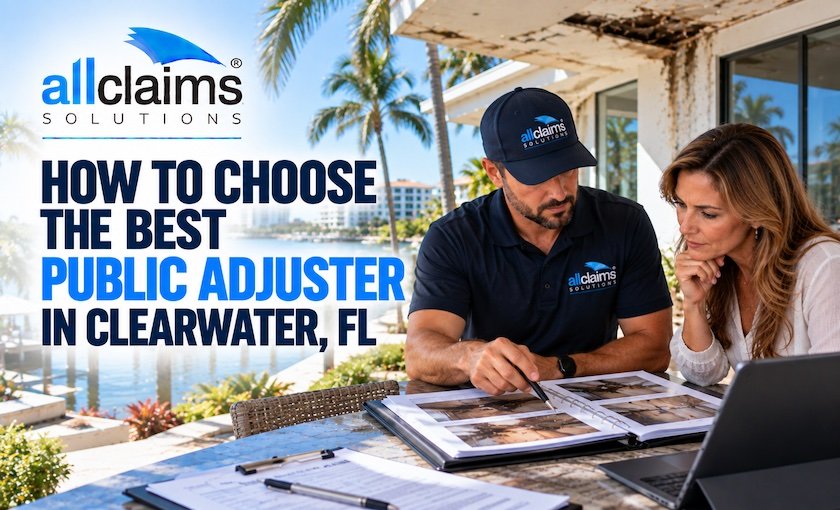
When your Clearwater property suffers significant damage, dealing with an insurance claim can become complicated quickly.
A storm can damage a roof and allow water into the property. A fire can affect the structure, contents, and personal belongings. A plumbing failure can create extensive water damage. A commercial property loss can also affect equipment, inventory, and business operations.
In these situations, some property owners choose to work with a public adjuster to assist with the insurance claim.
But how do you choose the right one?
The answer should not be based on a single online review, a promise about the outcome of a claim, or the lowest fee.
Instead, Clearwater property owners should look at several factors, including Florida licensing, relevant experience, communication, claim documentation, contract terms, fees, references, and the types of services provided.
At All Claims Solutions, we believe property owners should have enough information to make an informed decision about who they trust with their insurance claim.
What Is a Public Adjuster?
A public adjuster is an insurance professional who represents the policyholder, rather than the insurance company, in a property insurance claim.
Florida law defines a public adjuster as someone who, for compensation, prepares, completes, or files an insurance claim for an insured, or assists the insured in negotiating or effecting the settlement of a covered property insurance claim.
Florida’s Department of Financial Services also explains that a public adjuster does not represent the insurance company. Instead, the public adjuster represents the policyholder during the claims process.
A public adjuster may assist with areas such as:
- Property inspection
- Damage documentation
- Claim preparation
- Policy review
- Inventory documentation
- Estimates
- Claim presentation
- Communication with the insurer
- Negotiation of the documented claim
A public adjuster is not an attorney, and public adjusters cannot provide legal advice or handle bodily injury claims in the manner described under Florida law.
Do You Need a Public Adjuster in Clearwater?
Not every insurance claim requires a public adjuster.
A property owner can communicate directly with their insurance company and manage their own claim.
However, professional claim assistance may be considered when a claim involves:
- Extensive property damage
- Multiple types of damage
- A large or complicated loss
- Significant personal property
- Commercial property
- Business interruption
- A disputed scope of damage
- A denied claim
- An underpaid claim
- Additional damage discovered during repairs
- Extensive documentation
- A claims process that has become difficult to manage
Florida’s official Claim Process Disclosure Form specifically states that an insured is not required to hire a public adjuster, but has the right to do so.
The decision ultimately depends on the circumstances of the loss and the policyholder’s needs.
10 Things to Look for When Choosing a Public Adjuster in Clearwater
1. Verify the Public Adjuster’s Florida License
This should be one of the first things you check.
Florida DFS states that a public adjuster must be licensed and recommends asking for the adjuster’s license number and comparing it with government-issued identification.
Before signing a contract, verify the license through Florida’s official license search.
Do not rely solely on:
- A website
- A Google Business Profile
- Social media
- An advertisement
- A referral
The official license record provides a more reliable starting point.
What to ask
“Can you provide your Florida public adjuster license number?”
A professional should be comfortable providing this information.
2. Look for Experience With Your Type of Claim
Insurance claims can vary significantly.
A public adjuster who regularly handles residential water damage claims may have a different experience profile from one who focuses heavily on commercial property or large storm losses.
When evaluating a Clearwater public adjuster, ask whether they have experience with your particular type of loss.
For example:
Water Damage
- Plumbing leaks
- Pipe failures
- Water intrusion
- HVAC-related losses
- Commercial water damage
Storm Damage
- Wind damage
- Hurricane damage
- Roof damage
- Interior water intrusion
Fire Damage
- Fire
- Smoke
- Soot
- Water damage caused by firefighting
- Personal property losses
Other Claims
- Mold
- Structural damage
- Lightning
- Business interruption
- Supplemental claims
- Denied claims
- Underpaid claims
The goal is to find someone whose experience is relevant to your specific claim, not simply someone who advertises broadly.
3. Research the Company and Its Reputation
Online research can help you understand how a company communicates with clients and how it presents its services.
Florida’s Insurance Consumer Advocate recommends researching a public adjuster and checking references before hiring. Its consumer guidance specifically recommends reviewing public adjuster reviews and requesting references.
Look at several sources rather than relying on one review platform.
You can review:
- Google reviews
- Client testimonials
- Better Business Bureau information
- Company website
- Social media presence
- References provided by the firm
Look for patterns
Instead of focusing on one positive or negative review, look for recurring themes involving:
- Communication
- Responsiveness
- Professionalism
- Documentation
- Claim handling
- Transparency
- Follow-up
Reviews are useful context, but they should be considered alongside licensing, contract terms, experience, and the services actually offered.
4. Ask Who Will Actually Handle Your Claim
This is an important question that property owners sometimes overlook.
You may initially speak with a company representative, but another adjuster could eventually handle the claim.
Before signing, ask:
- Who will inspect my property?
- Who will prepare my estimate?
- Who will communicate with the insurance company?
- Who will be my primary point of contact?
- How often will I receive updates?
- Who will handle questions about my claim?
Good communication can make a complicated claims process easier to manage.
5. Understand the Public Adjuster’s Fee
Public adjusters generally work for a fee or percentage of the claim payment, so it is important to understand exactly how compensation works before signing a contract.
Florida law establishes limits on public adjuster compensation. Under current 2026 Florida Statutes, compensation generally cannot exceed 20% of applicable claim payments for claims not based on a gubernatorial state of emergency, while claims based on events subject to a state-of-emergency declaration are subject to a 10% limit during the first year after the declaration. Additional rules apply to reopened or supplemental claims and certain other circumstances.
Florida DFS also advises consumers to understand the fee arrangement before signing a public adjusting contract.
Questions to ask
- What percentage is your fee?
- What payments does the fee apply to?
- Are there additional costs?
- Are third-party services involved?
- Who pays those costs?
- How are reopened or supplemental claims handled?
- Are there any expenses I could be responsible for?
The answers should be clearly reflected in the contract.
6. Read the Contract Before Signing
Never choose a public adjuster based only on a conversation.
Read the actual contract.
Florida DFS provides consumer guidance specifically recommending that policyholders review public adjusting contracts carefully. Current Florida law also establishes specific contract and cancellation requirements.
The contract should clearly identify relevant information such as:
- Public adjuster’s name
- Public adjusting firm’s name
- License information
- Contact information
- Description of the loss
- Compensation
- Applicable fees
- Required disclosures
- Cancellation provisions
Florida’s public adjuster contract requirements also address the written estimate that the public adjuster must provide within 60 days, subject to the statutory exception for circumstances beyond the adjuster’s control.
Don’t rush.
If someone pressures you to sign immediately without giving you time to read and understand the agreement, that is a reason to slow down and review the terms carefully.
7. Understand Your Cancellation Rights
Florida law gives insureds a right to cancel a public adjuster’s contract without penalty within 10 days after the contract is executed.
For contracts entered into based on events that are the subject of a gubernatorial state-of-emergency declaration, the law provides a longer cancellation period: 30 days after the date of loss or 10 days after execution of the contract, whichever is longer. The statute also addresses cancellation if the required written estimate is not provided within 60 days, subject to the statutory exception.
These rules are important enough that property owners should read the cancellation language in the actual contract rather than relying on a verbal explanation.
8. Ask How the Claim Will Be Documented
A strong claims process requires documentation.
Ask the public adjuster how they handle:
Property Documentation
- Photographs
- Videos
- Measurements
- Inspection reports
- Damage descriptions
Personal Property
- Inventory
- Receipts
- Purchase information
- Photographs
- Replacement information
Repair Estimates
- Scope of work
- Materials
- Labor
- Equipment
- Other applicable costs
Claim Records
- Correspondence
- Insurer estimates
- Adjuster reports
- Claim communications
- Additional damage
The goal is to create a well-organized record of the documented loss.
9. Look for Clear Communication
Insurance claims can take time and involve multiple inspections, estimates, requests for information, and discussions with the insurer.
Ask the public adjuster:
“How will you keep me updated about my claim?”
Useful questions include:
- How often will you provide updates?
- Who should I contact with questions?
- Will I receive copies of important documents?
- How quickly do you normally respond?
- How are claim delays communicated?
10. Make Sure the Public Adjuster Represents You
One of the fundamental differences between a public adjuster and an insurance company adjuster is who they represent.
Public Adjuster
Represents the policyholder.
Company Adjuster
Works for the insurance company.
Independent Adjuster
May be contracted by the insurance company to adjust claims on its behalf.
Florida’s official Claim Process Disclosure Form explains these distinctions and states that a public adjuster contracts with and is compensated by the insured to assist in the insurance claim process.
Understanding this distinction is important before choosing professional claim assistance.
Public Adjuster vs. Contractor: What’s the Difference?
These professionals have different roles.
| Public Adjuster | Contractor |
|---|---|
| Handles insurance claim adjustment | Handles repairs/restoration |
| Represents the policyholder | Performs construction or restoration work |
| Documents the insurance loss | Estimates repair work |
| Helps prepare the claim | Repairs damaged property |
| Communicates regarding claim scope | Communicates regarding construction scope |
Florida DFS states that a contractor cannot perform public adjusting services unless properly licensed as a public adjuster.
A contractor can discuss a repair estimate or bid, but that does not make the contractor the policyholder’s insurance adjuster.
Public Adjuster vs. Insurance Company Adjuster
The distinction is straightforward:
Your Public Adjuster
→ Represents you, the policyholder.
Insurance Company Adjuster
→ Works on behalf of the insurance company.
Both may inspect the same property and evaluate the same loss, but they have different roles in the claims process.
Florida DFS confirms that public adjusters represent the policyholder rather than the insurer.
Red Flags to Watch For When Choosing a Public Adjuster
While every situation is different, Clearwater property owners should be cautious about arrangements involving:
Pressure to Sign Immediately
You should have an opportunity to read the contract and understand its terms.
Unclear Fees
If you cannot clearly determine how the public adjuster is compensated, ask for clarification before signing.
Unverified Licensing
Florida requires public adjusters to be licensed. Verify the license independently.
Promises of a Guaranteed Settlement
No professional can guarantee a specific insurance settlement based solely on being hired.
Claims of Government Endorsement
Florida law prohibits public adjuster advertising that falsely implies governmental sanction or endorsement.
Offers to Pay You to File a Claim
Florida law prohibits certain inducements to encourage insureds to submit claims.
Contractor and Public Adjuster Roles Being Blurred
A contractor cannot perform public adjusting services unless properly licensed.
Does the “Best” Public Adjuster Mean the One With the Lowest Fee?
Not necessarily.
The lowest percentage does not automatically tell you how a firm handles a claim.
When comparing public adjusters, consider the complete service offering, including:
- Licensing
- Relevant experience
- Documentation process
- Communication
- Contract transparency
- Fee structure
- References
- Local experience
- Claim types handled
- Availability
The goal is to understand exactly what you are paying for and whether the firm’s services fit your situation.
Should You Choose a Local Public Adjuster in Clearwater?
Local experience can be one factor to consider when evaluating a public adjuster.
A Clearwater-focused firm may be familiar with property types and claim scenarios common in the area, including:
- Coastal properties
- Residential communities
- Condominiums
- Commercial properties
- Storm-related losses
- Water damage
- Fire damage
- Roof damage
However, geographic location should be considered alongside licensing, experience, service quality, contract terms, and the specific needs of the claim.
What Types of Claims Can a Clearwater Public Adjuster Handle?
Depending on the firm’s experience and services, public adjusters may assist with claims involving:
Storm Damage
Wind and storm-related property damage.
Hurricane Damage
Property losses following a hurricane or tropical system.
Water Damage
Covered plumbing, water intrusion, and related property losses.
Fire Damage
Fire, smoke, soot, and related damage.
Roof Damage
Covered roof damage associated with applicable causes of loss.
Mold Damage
Coverage depends heavily on the source of the mold and the policy.
Structural Damage
Damage affecting structural components of the property.
Commercial Claims
Building, equipment, inventory, and other commercial property losses.
Denied or Underpaid Claims
Claims where the policyholder disputes the insurer’s handling, scope, or payment.
The exact services and coverage issues depend on the claim and policy.
When Should You Consider Hiring a Public Adjuster?
You may want to explore professional claim assistance if:
- You have extensive property damage.
- Multiple rooms or systems are affected.
- You are unsure how to document the loss.
- Your insurance estimate appears incomplete.
- You discover additional damage.
- Your claim has been denied.
- Your claim appears underpaid.
- Your business operations are affected.
- You have significant personal property losses.
- You do not have time to manage the claim yourself.
You do not have to hire a public adjuster simply because you have filed an insurance claim.
The decision should depend on the complexity of the loss and the level of assistance you need.
How All Claims Solutions Helps Clearwater Property Owners
At All Claims Solutions, we work for policyholders—not insurance companies.
Our licensed Public Adjusters assist Clearwater property owners with the claims process, including:
Property Inspection
We document the condition of the property and identify the scope of visible damage.
Claim Documentation
We organize photographs, estimates, inventories, reports, and other supporting information.
Policy Review
We review the applicable policy provisions relevant to the documented loss.
Claim Preparation
We help prepare and organize the insurance claim.
Insurance Company Communication
We communicate with the insurer regarding the documented claim.
Claim Negotiation
We represent the policyholder in discussions concerning the documented scope of loss.
Our goal is to help property owners understand their claim and navigate the process with organized documentation.
Your Clearwater Public Adjuster Checklist
Before signing a contract:
☐ Verify the Florida public adjuster’s license
☐ Research the firm
☐ Review independent reviews
☐ Ask for references
☐ Ask about experience with your type of claim
☐ Ask who will handle your claim
☐ Understand the fee structure
☐ Ask about additional costs
☐ Read the complete contract
☐ Understand cancellation provisions
☐ Ask how the claim will be documented
☐ Ask how communication will work
☐ Make sure you receive a copy of the signed agreement
☐ Never rely solely on promises about a future settlement
Why Choosing the Right Public Adjuster Matters
An insurance claim can involve significant documentation, policy interpretation, estimates, inspections, correspondence, and negotiations.
The right professional for your situation should be someone whose:
- License you can verify
- Experience you can understand
- Fees you can clearly identify
- Contract you can read
- Services you can define
- Communication process you can understand
Florida DFS encourages consumers to verify a public adjuster’s license, research the firm, check references, and review the contract before hiring.
Taking the time to evaluate these factors can help you make a more informed decision about professional claim assistance.
Frequently Asked Questions
Start by verifying the adjuster’s Florida license. Then evaluate relevant experience, reviews, references, communication, services, fees, and contract terms. Florida DFS specifically recommends researching public adjusters, checking references, verifying licensing, and reviewing the contract before signing.
The appropriate process depends on the insurer, policy, type of dispute, and circumstances. Start by reviewing the denial and asking the insurer to explain the basis of its decision. Additional documentation may also be relevant.
Florida DFS provides a licensee search that consumers can use to verify licensing information. DFS also recommends asking the public adjuster for their license number.
Public adjusters generally charge a fee or percentage of applicable claim payments. Florida law establishes compensation limits, which vary depending on the type and circumstances of the claim. Current law generally provides a 20% maximum for non-emergency claims and a 10% limit for qualifying claims based on events subject to a gubernatorial state-of-emergency declaration during the first year after the declaration, with additional rules for reopened and supplemental claims.
Florida law generally allows an insured to cancel a public adjuster contract without penalty within 10 days after execution. For contracts based on events subject to a gubernatorial state-of-emergency declaration, a longer cancellation period applies. The statute also provides a cancellation right if the required written estimate is not provided within 60 days, subject to the statutory exception.
No. Florida’s official Claim Process Disclosure Form states that policyholders are not required to hire a public adjuster but have the right to do so.
A contractor may not perform public adjusting services unless properly licensed as a public adjuster. Florida DFS specifically distinguishes repair work from public adjusting services.
No professional should guarantee a particular settlement amount. The outcome of an insurance claim depends on the policy, documented damage, coverage, evidence, and circumstances.
Ask about licensing, experience, fees, additional costs, claim documentation, communication, references, contract terms, cancellation rights, and who will actually handle your claim.
Get Help With Your Clearwater Insurance Claim
Choosing a public adjuster is an important decision, particularly when a property loss is extensive or complicated.
At All Claims Solutions, our licensed Public Adjusters work for the policyholder—not the insurance company.
We help Clearwater property owners with residential and commercial insurance claims involving water, fire, storm, hurricane, roof, mold, structural, and other covered property losses.
If you are considering professional claim assistance, you can start with a Free Insurance Claim Evaluation.
All Claims Solutions – Clearwater
📍 600 Cleveland St., Suite 382, Clearwater, FL 33755
📞 24/7: 727-336-0627
🌐 clearwater.allclaimssolutions.com
✉️ info@all-claims.com
No Recovery – No Fee.
This article is for general informational purposes only and does not constitute legal advice or a determination of insurance coverage. Insurance coverage depends on the specific policy, endorsements, exclusions, deductibles, limits, and circumstances of the loss. Florida insurance laws and requirements may change.