
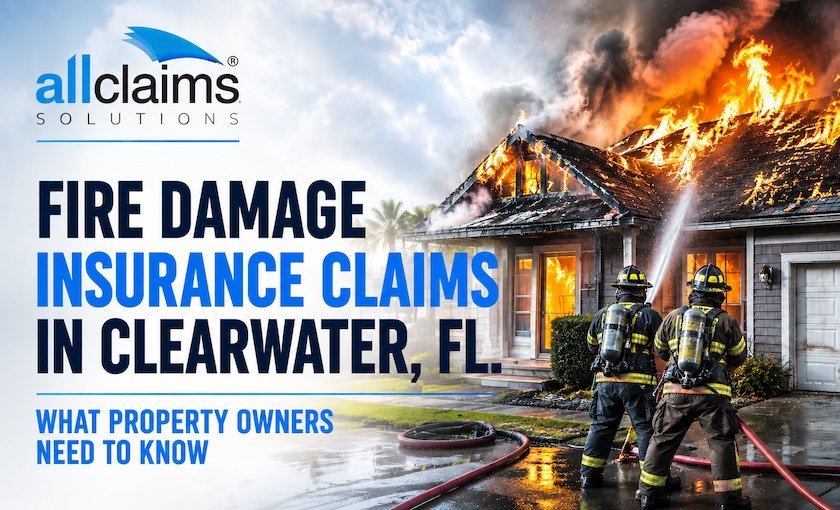
A fire can change everything in a matter of minutes.
Flames can destroy parts of a property, while smoke, soot, heat, and water used to extinguish the fire can create additional damage throughout the building.
For property owners in Clearwater, FL, the aftermath of a fire can bring difficult questions:
- What does my insurance policy cover?
- Is smoke damage covered?
- What about water damage caused by firefighters?
- How do I document everything?
- What happens if my insurance claim is denied?
- What if the insurance company’s estimate doesn’t cover the full cost of repairs?
- Should I hire a Public Adjuster?
Understanding the insurance claims process can help you make informed decisions after a fire.
At All Claims Solutions, our licensed Public Adjusters represent policyholders—not insurance companies. We help Clearwater property owners document property damage, prepare insurance claims, and navigate the claims process.
We Work for You—not the Insurance Company.
Does Homeowners Insurance Cover Fire Damage in Clearwater, FL?
In many homeowners insurance policies, fire is a covered peril. Florida’s Office of the Insurance Consumer Advocate explains that homeowners insurance can protect against damage caused by covered perils such as fire, although the exact coverage depends on the policy.
Depending on the policy, coverage may potentially apply to damage involving:
- The structure of the property
- Roof and ceilings
- Walls and flooring
- Electrical and plumbing systems
- Cabinets and built-ins
- Personal belongings
- Furniture
- Appliances
- Electronics
- Smoke and soot damage
- Water damage resulting from firefighting efforts
- Additional living expenses when applicable
However, not every fire-related loss is automatically covered.
Your policy’s coverage limits, exclusions, deductibles, endorsements, conditions, and the circumstances surrounding the fire all matter.
That is why property owners should review their individual insurance policy rather than relying on general assumptions about fire coverage.
What Types of Damage Can a Fire Cause?
One of the biggest mistakes property owners can make after a fire is focusing only on the area where the flames were located.
A fire can create several different categories of damage.
1. Structural Fire Damage
Flames and extreme heat can damage:
- Walls
- Ceilings
- Roof structures
- Flooring
- Doors
- Windows
- Framing
- Electrical systems
- Plumbing systems
- HVAC systems
In severe fires, portions of the property may require extensive reconstruction.
2. Smoke Damage
Smoke can travel far beyond the location of the fire.
It may affect:
- Walls
- Ceilings
- Furniture
- Clothing
- Electronics
- Cabinets
- Appliances
- HVAC systems
- Personal belongings
Smoke odors can also remain long after visible soot has been removed.
3. Soot Damage
Soot can settle on surfaces throughout a property.
Depending on the fire and materials involved, soot may affect:
- Walls
- Ceilings
- Furniture
- Flooring
- Appliances
- Electronics
- Clothing
- Other personal property
Some items may require specialized cleaning or replacement.
4. Water Damage From Firefighting
Fire damage isn’t always limited to flames and smoke.
Firefighters may use significant amounts of water to extinguish a fire, potentially creating additional damage to:
- Flooring
- Drywall
- Ceilings
- Insulation
- Furniture
- Cabinets
- Personal property
This means a fire insurance claim may involve fire damage, smoke damage, soot damage, and water damage at the same time.
5. Hidden Damage
Some damage may not be immediately visible.
For example, heat, smoke, or water may affect areas behind:
- Walls
- Ceilings
- Flooring
- Cabinets
- Insulation
This is one reason why a thorough inspection and detailed documentation are important before major repairs begin.
What Does Fire Insurance Typically Cover?
Coverage depends on your policy, but a property insurance claim after a fire can potentially involve several categories.
Dwelling or Building Coverage
May apply to covered damage to the physical structure.
Personal Property Coverage
May apply to covered damage to belongings such as furniture, clothing, electronics, appliances, and other personal property.
Additional Living Expenses
If covered fire damage makes a home uninhabitable, the policy may provide Additional Living Expenses (ALE) subject to the policy’s terms and limits. Florida’s consumer guidance identifies ALE as coverage that can help with certain additional expenses when a policyholder is displaced because of covered damage.
Other Structures
Depending on the policy, certain detached structures may have separate coverage.
Loss of Use
Certain policies may provide coverage when a covered loss prevents normal use of the property.
The important point is that coverage is policy-specific.
What About Smoke Damage After a Fire?
Smoke damage deserves special attention.
A fire doesn’t have to destroy an entire building for smoke to create a significant insurance claim.
Smoke can move through ventilation systems and settle throughout rooms that were never directly touched by flames.
For example:
Kitchen Fire
↓
Smoke travels through HVAC system
↓
Smoke affects bedrooms and living areas
↓
Odors and soot remain throughout the property
↓
Furniture, clothing and other belongings may be affected
A complete fire damage claim should consider the areas affected by smoke and soot—not just the location where the fire started.
What About Water Damage Caused by Firefighters?
Fire suppression can sometimes create substantial secondary damage.
Water used to extinguish a fire can enter areas that were not directly damaged by flames.
This may result in:
- Wet drywall
- Damaged flooring
- Moisture inside walls
- Damaged insulation
- Water-damaged furniture
- Potential mold growth
- Additional restoration requirements
Property owners should document this damage as part of the overall loss.
What Should You Do After a Fire in Clearwater?
The first priority is always safety.
Once authorities determine that it is safe to access the property, there are several important steps property owners should consider.
1. Make Sure Everyone Is Safe
Do not enter a fire-damaged structure until the appropriate authorities determine that it is safe.
If there is an immediate emergency, call 911.
2. Report the Loss to Your Insurance Company
Notify your insurance company as soon as reasonably possible and follow the reporting requirements in your policy.
Florida consumer guidance recommends promptly reporting property damage and following the insurer’s claim procedures.
3. Document the Damage
Take photographs and videos of as much of the property as safely possible.
Document:
- Structural damage
- Smoke damage
- Soot
- Water damage
- Damaged rooms
- Roof damage
- Furniture
- Appliances
- Electronics
- Clothing
- Personal belongings
Create documentation before damaged items are cleaned, removed, or discarded whenever reasonably possible.
4. Prevent Additional Damage
Take reasonable emergency measures to protect the property from further damage.
Florida’s Department of Financial Services recommends taking reasonable steps to prevent additional damage and documenting emergency repairs with photographs, videos, and receipts.
5. Keep Your Receipts
Save receipts for:
- Emergency repairs
- Temporary housing
- Hotel stays
- Meals when potentially covered
- Storage
- Cleaning
- Boarding pets when applicable
- Replacement necessities
- Other fire-related expenses
These documents can help support your claim.
6. Create a Detailed Inventory
A fire can destroy hundreds of individual belongings.
Create a list that includes:
- Item
- Description
- Quantity
- Approximate age
- Original cost if known
- Replacement cost information
- Photos
- Receipts
- Serial numbers when available
Florida consumer guidance also recommends maintaining inventories and documentation to help establish the value of damaged property.
Don’t Throw Away Damaged Property Too Quickly
After a fire, it can be tempting to clean everything immediately.
But damaged items can provide important evidence about the scope and severity of the loss.
Whenever reasonably possible:
Document first.
Preserve evidence.
Then determine what can be cleaned, restored, or replaced.
If damaged materials must be removed because they pose a safety hazard, document them with photographs or video first when possible. Florida’s Department of Financial Services specifically recommends documenting damaged items before disposal when safety allows.
Common Fire Damage Insurance Claim Mistakes
Mistake #1: Only Documenting the Burned Area
Smoke and water damage can extend far beyond the location of the flames.
Mistake #2: Forgetting Personal Property
Furniture, electronics, clothing, appliances, and other belongings can represent a significant portion of the loss.
Mistake #3: Ignoring Smoke and Soot Damage
A room doesn’t have to burn completely to sustain significant smoke or soot damage.
Mistake #4: Overlooking Water Damage
Water used to extinguish the fire can create additional property damage.
Mistake #5: Discarding Items Without Documentation
Destroyed items may be difficult to value after they are gone.
Mistake #6: Focusing Only on the Insurance Company’s Estimate
An insurer’s initial estimate may not necessarily reflect every item or component of the documented loss.
Florida law requires certain residential property insurers to provide explanations when paying, denying, or partially denying claims, and preliminary or partial estimates may be revised as the claim continues to be evaluated.
Mistake #7: Forgetting Additional Living Expenses
If your home becomes uninhabitable after a covered fire, review whether your policy provides ALE or loss-of-use coverage.
How Long Do You Have to File a Fire Insurance Claim in Florida?
Florida’s current property insurance statute generally requires notice of an initial claim within 1 year after the date of loss. The same one-year period generally applies to a reopened claim, while a supplemental claim generally must be reported within 18 months after the date of loss.
These deadlines are important.
However, property owners should also review their individual policy and the specific circumstances of the loss.
Don’t wait until the deadline is approaching to start documenting your claim.
The sooner you understand the scope of the damage and applicable requirements, the more time you have to organize the claim.
What If the Insurance Company Denies Your Fire Damage Claim?
A fire damage claim can sometimes be denied or partially denied.
An insurer may dispute:
- The cause of the fire
- Whether the loss is covered
- The extent of damage
- Whether certain damage resulted from the fire
- Smoke or soot damage
- Water damage
- Personal property losses
- The amount of the claimed loss
If your claim is denied, carefully review the insurer’s written explanation and the policy provisions it relies upon.
You may also want to have the claim independently evaluated before deciding what to do next.
Related Resource:
Denied Insurance Claim Help in Clearwater, FL
This is an ideal internal link from this section.
What If Your Fire Insurance Claim Is Underpaid?
A claim doesn’t have to be completely denied to create a problem.
An insurer may accept that a fire caused covered damage but disagree about the amount of the loss.
For example, the initial estimate may not fully account for:
- Structural repairs
- Smoke remediation
- Soot cleaning
- Water damage
- Personal property
- Hidden damage
- Code-related costs when applicable
- Additional living expenses
- Other covered components of the loss
When there is a disagreement about the scope or value of a claim, detailed documentation becomes particularly important.
Related Resource:
Why Insurance Claims Get Underpaid
Can a Public Adjuster Help With a Fire Damage Claim?
Yes, a licensed Public Adjuster can represent the policyholder during the insurance claims process.
Florida’s Department of Financial Services explains that a Public Adjuster represents the policyholder rather than the insurance company and may assist with claim documentation, filing requirements, and pursuing amounts owed under the insurance contract.
A Public Adjuster may help with:
Property Inspection
Evaluating the scope of damage throughout the property.
Documentation
Organizing photographs, videos, inventories, estimates, and other evidence.
Policy Review
Identifying potentially relevant coverages, limits, deductibles, exclusions, and endorsements.
Claim Preparation
Preparing a detailed presentation of the documented loss.
Personal Property
Helping organize information about damaged or destroyed belongings.
Additional Expenses
Documenting potentially covered expenses related to the loss.
Communication
Helping manage communications with the insurance company.
Negotiation
Representing the policyholder during discussions regarding the documented claim.
Public Adjusters in Florida must be licensed by the Department of Financial Services. Property owners should verify a Public Adjuster’s license and carefully review the contract before signing.
When Should You Consider Hiring a Public Adjuster?
You are not required to hire a Public Adjuster.
However, professional claim assistance may be worth considering when:
- The fire caused extensive damage
- Multiple rooms were affected
- Smoke damage extends throughout the property
- There is significant water damage
- Personal property was destroyed
- The insurance estimate appears incomplete
- The claim has been partially denied
- The claim has been denied
- You disagree with the insurer’s scope
- You don’t have time to manage the claim yourself
A Public Adjuster also does not guarantee a particular settlement. The role is to represent the policyholder and help document and present the claim according to the applicable policy.
Fire Damage Claims for Clearwater Businesses
Fire damage can be especially disruptive for commercial property owners.
A business fire may affect:
- The building
- Equipment
- Inventory
- Furniture
- Computers
- Machinery
- Customer areas
- Office space
- Business operations
Depending on the commercial policy, the claim may also involve business income or extra expense coverage.
For a business owner, the financial impact can therefore extend well beyond the cost of repairing the physical building.
Related Resource:
Commercial Property Insurance Claims in Clearwater
This would be an excellent internal link for strengthening the commercial claims cluster.
Fire Damage Claims in Clearwater: What Property Owners Should Remember
After a fire, it’s easy to focus on the most obvious damage.
But a complete insurance claim may involve much more than the burned structure.
Think about the entire loss:
FIRE
↓
SMOKE
↓
SOOT
↓
WATER
↓
STRUCTURAL DAMAGE
↓
PERSONAL PROPERTY
↓
ADDITIONAL EXPENSES
↓
POTENTIAL BUSINESS INTERRUPTION
The goal is to understand and document the full scope of the covered loss.
Why Clearwater Property Owners Choose All Claims Solutions
A fire can leave property owners dealing with contractors, insurance companies, restoration companies, temporary housing, damaged belongings, and difficult financial decisions—all at the same time.
At All Claims Solutions, our Public Adjusters help property owners throughout Clearwater and surrounding Pinellas County communities navigate the insurance claims process.
We focus on:
INSPECT
↓
DOCUMENT
↓
REVIEW
↓
PREPARE
↓
PRESENT
↓
NEGOTIATE
We Work for You—not the Insurance Company.
Frequently Asked Questions About Fire Damage Insurance Claims in Clearwater
Many homeowners policies provide coverage for fire damage, but coverage depends on the specific policy, exclusions, limits, endorsements, and circumstances of the loss. Florida’s Department of Financial Services recommends reviewing your individual policy rather than assuming all fire-related losses are covered.
Smoke damage may be covered when it results from a covered fire, but the applicable coverage depends on the policy and circumstances of the loss.
Water damage resulting from firefighting efforts may be part of a covered fire loss, depending on the policy and circumstances. The damage should be documented as part of the overall claim.
Prioritize safety, report the loss to your insurer, document the damage, take reasonable steps to prevent additional damage, preserve damaged property when possible, and keep receipts and other records.
Under current Florida law, property insurance claims generally must be reported within 1 year after the date of loss, subject to the statute and applicable policy requirements. Supplemental claims generally have an 18-month notice period.
Review the denial letter, policy language, cause of loss, and supporting documentation. If you disagree with the decision, consider having the claim independently evaluated.
Review the insurer’s estimate against the documented scope of damage, including structural damage, smoke, soot, water damage, personal property, and other potentially covered losses.
A licensed Public Adjuster can represent the policyholder during the claims process and assist with documentation, claim preparation, and negotiations with the insurance company.
Yes. Florida Public Adjusters must be licensed by the Department of Financial Services. Consumers should verify the license and review the contract carefully before signing.
Get Help With a Fire Damage Insurance Claim in Clearwater, FL
A fire can damage much more than the area where the flames were visible.
Smoke.
Soot.
Water.
Structural damage.
Personal property.
Additional expenses.
Every part of the loss should be properly evaluated and documented.
If your Clearwater property has suffered fire damage, don’t assume the first estimate tells the entire story.
Let our team help you understand your insurance claim.
All Claims Solutions – Clearwater Public Adjusters
We Work for You—not the Insurance Company.
No Recovery – No Fee.
24/7 Service
This article is for general informational purposes only and does not constitute legal advice or a determination of insurance coverage. Insurance coverage depends on the specific policy, applicable endorsements, exclusions, limits, deductibles, and circumstances of the loss. Florida laws and insurance requirements may change.




[…] Read our guide to Fire Damage Insurance Claims in Clearwater […]
[…] Related: [Fire Damage Insurance Claims in Clearwater, FL] […]