Receiving an insurance payment after property damage can provide some financial relief. However, what happens when the amount offered by your insurance company does not appear to account for all the damage or necessary repairs?
For homeowners and business owners in Clearwater, Florida, an underpaid insurance claim can create unexpected financial challenges. Missing damage, incomplete repair estimates, disputed costs, or differences in how policy coverage is interpreted can all contribute to disagreements over the amount of a claim.
An insurance payment does not necessarily mean that every aspect of a covered loss has been fully evaluated. Property owners should understand how to review their settlement, identify potential discrepancies, and determine what steps may be available when they believe their claim has been underpaid.
At All Claims Solutions, we help Clearwater property owners document their losses, prepare insurance claims, and navigate the claims process. Our Public Adjusters represent policyholders, not insurance companies.
What Is an Underpaid Insurance Claim?
An underpaid insurance claim occurs when a property owner believes that the amount paid or offered by an insurance company does not adequately reflect the covered damage or the benefits available under the insurance policy.
This situation may arise when an insurer’s estimate does not include all documented damage, certain repair costs are disputed, or the scope of work does not adequately address the covered loss.
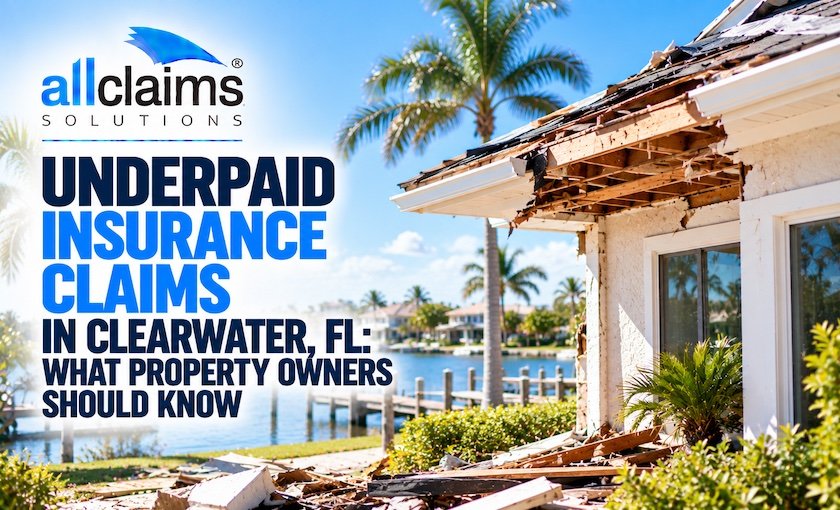
For example, a Clearwater homeowner may experience roof damage after a severe storm. The insurance company may approve some repairs, but a subsequent inspection could identify additional damage to roofing components or interior areas that was not included in the original estimate.
In this situation, the property owner may have grounds to request further review, depending on the policy, available evidence, and applicable claim requirements.
An underpaid claim is not necessarily an incorrect payment. The difference between an insurance estimate and a contractor’s estimate does not, by itself, establish that the insurer owes additional benefits. The policy, cause of loss, supporting documentation, and applicable coverage provisions must be considered.
Common Reasons Insurance Claims Are Underpaid
Several factors can contribute to disagreements over the amount of an insurance payment. Understanding them can help Clearwater property owners identify areas that may require further review.
1. Missing or Undocumented Property Damage
Not all property damage is immediately visible.
After a hurricane, severe storm, plumbing leak, or fire, some damage may only become apparent during repairs or a more detailed inspection.
Examples include:
- Hidden water damage behind walls or ceilings.
- Damaged roof decking or structural components.
- Moisture affecting insulation and building materials.
- Additional damage discovered during demolition.
- Smoke and soot damage in areas beyond the visibly burned space.
If relevant damage was not identified or documented during the initial inspection, it may not appear in the original estimate.
Property owners should document newly discovered damage and determine whether it may qualify for additional coverage.
2. Incomplete Repair Estimates
An insurance estimate may not include every repair activity required to restore a property after a covered loss.
Potential areas to review include:
- Labor and material quantities.
- Removal and disposal of damaged materials.
- Necessary demolition.
- Repairs to affected building components.
- Applicable building requirements.
- Specialized restoration work.
- Necessary temporary protection.
An estimate should be evaluated against the actual documented damage and applicable policy provisions. Differences in pricing or scope should be reviewed individually rather than automatically treated as underpayment.
3. Disagreements Over Repair Costs
Property owners may receive estimates from contractors that differ significantly from the insurance company’s estimate.
These differences can involve material prices, labor requirements, quantities, repair methods, or the scope of work.
A contractor’s estimate can provide useful information, but it does not automatically determine the amount payable under an insurance policy.
The important step is to identify the specific differences and support any requested adjustments with appropriate documentation.
4. Damage Categorization and Coverage Disputes
Some insurance claims involve several types of damage arising from the same event.
For example, a Clearwater property affected by a hurricane may have roof damage, water intrusion, damaged flooring, and structural concerns.
The insurer may accept some portions of the claim while disputing others. In these situations, it is important to understand the stated reason for each coverage decision and whether the supporting evidence addresses it.
5. Incomplete Documentation
Photographs, inspection reports, repair estimates, invoices, and other records can be important when evaluating an insurance claim.
If relevant information is missing, it may be more difficult to demonstrate the extent of the damage or support the requested repair costs.
Maintaining organized documentation throughout the process can help property owners respond to questions and identify potential discrepancies.
Important: An estimate that differs from a contractor’s quote does not automatically mean the insurance company has underpaid a claim. The difference should be evaluated in light of the policy, documented damage, and the insurer’s explanation.
Signs Your Insurance Claim May Have Been Underpaid
If you have already received an insurance payment, there are several situations that may justify reviewing the claim more closely.
- The repair estimate does not reflect the visible damage. Some damaged areas or necessary repairs may be missing.
- Additional damage was discovered. A contractor or qualified inspector identified damage that was not included in the original assessment.
- The approved scope of repairs seems incomplete. The estimate may not address all documented work needed for the covered loss.
- Your contractor identified specific discrepancies. There may be measurable differences in materials, quantities, or necessary repairs.
- Some portions of the claim were excluded. The insurer may have disputed certain items or explained that they are not covered.
- You received a partial payment. The insurer may have approved only part of the claimed damage, subject to policy provisions and applicable deductibles.
These situations are reasons to examine the claim, not proof that additional payment is owed.
What to Do If Your Insurance Claim Is Underpaid in Clearwater, FL
If you believe your property insurance claim was underpaid, a structured review can help you understand the available options.
1. Review Your Insurance Company’s Estimate
Start by requesting and carefully reviewing the estimate used to evaluate your claim.
Compare it with the damage you have documented and the repairs that may be necessary.
Pay particular attention to:
- Areas of damage included in the estimate.
- Items that were excluded or omitted.
- Quantities and measurements.
- Labor and material costs.
- Applicable depreciation.
- Deductibles.
- Coverage limits.
- The insurer’s explanation for disputed items.
Keep a copy of the estimate and any correspondence explaining the payment.
2. Review Your Insurance Policy
Your insurance policy determines which losses may be covered and under what conditions.
Review the relevant sections, including:
- Covered causes of loss.
- Exclusions.
- Deductibles.
- Coverage limits.
- Replacement cost and actual cash value provisions.
- Duties after a loss.
- Requirements for submitting additional documentation.
If the policy language is unclear, consider requesting an explanation from your insurer or obtaining qualified professional assistance.
3. Obtain Supporting Repair Documentation
A detailed repair estimate can help clarify differences between the insurer’s assessment and the work proposed by a contractor.
Depending on the type of damage, supporting documentation may include:
- Itemized repair estimates.
- Photographs and videos.
- Inspection reports.
- Moisture assessments.
- Structural engineering reports.
- Material invoices.
- Repair receipts.
- Mitigation records.
For complex claims, additional professional evaluations may be appropriate.
4. Document Newly Discovered Damage
If additional damage becomes apparent during repairs, record it as soon as possible.
Photograph the affected areas, keep invoices and reports, and preserve relevant correspondence.
When repairs are necessary for safety or to prevent further damage, take reasonable steps to protect the property. Document the condition and retain records of emergency work whenever possible.
5. Submit a Written Request for Review
If you identify specific discrepancies, consider sending the insurer a written request for further review.
A useful request should include:
- The claim number.
- A description of the disputed items.
- The relevant portions of the insurance estimate.
- Supporting photographs and reports.
- Additional repair estimates, where appropriate.
- An explanation of why you believe the items warrant reconsideration.
Keep a copy of everything you submit and record when it was sent.
6. Consider Professional Claim Assistance
When a claim involves extensive damage, disputed coverage, or significant differences in repair estimates, professional assistance may help you organize the information and understand the claim process.
A licensed Public Adjuster can review claim documentation, help prepare and present a claim, and communicate with the insurer on behalf of the policyholder.
The appropriate next step depends on the circumstances of the loss, the policy, and the status of the claim.
Underpaid Insurance Claims After Hurricanes and Storms in Clearwater
Clearwater properties can experience several forms of damage during severe weather. A single storm may affect roofing materials, structural components, windows, exterior walls, and interior finishes.
When a claim involves multiple types of damage, reviewing the full scope of the loss is particularly important.
For example, a storm damage claim may include:
- Roof damage caused by wind.
- Interior water damage associated with a covered opening.
- Damaged ceilings and insulation.
- Damaged exterior components.
- Additional repairs identified during restoration.
Each item must be evaluated according to the applicable coverage and evidence. Windstorm deductibles, exclusions, and policy-specific requirements may also affect the amount payable.
Property owners who believe their storm damage claim is incomplete should compare the insurer’s estimate with the documented condition of the property.
Related articles:
- Hurricane Damage Insurance Claims in Clearwater, FL
- Storm Damage Insurance Claims in Clearwater, FL
- Roof Damage Insurance Claims in Clearwater, FL
Underpaid Water Damage Claims
Water damage claims can be particularly challenging because the visible damage may not reveal the full extent of the loss.
For example, a plumbing leak may damage flooring and cabinets while also affecting concealed materials. Additional damage might become visible only after materials are removed during repairs.
When reviewing a water damage claim, consider whether the documentation addresses:
- The source of the water.
- The affected rooms and building components.
- The extent of visible and documented hidden damage.
- Necessary water mitigation.
- Repair and replacement requirements.
- Applicable policy exclusions and limitations.
The source of the water is especially important. A plumbing leak, water backup, and flooding may be subject to different coverage provisions.
Learn more about Water Damage Insurance Claims in Clearwater, FL
Underpaid Commercial Property Insurance Claims
Commercial property claims can involve considerably more than building repairs.
A Clearwater business may need to document damage to:
- Commercial buildings.
- Roofing systems.
- Equipment and machinery.
- Furniture and fixtures.
- Inventory.
- Interior finishes.
- Other insured business property.
Depending on the policy and circumstances, a commercial claim may also involve business income losses or additional expenses incurred to continue operations.
Business income coverage generally has specific requirements, including qualifying physical damage to insured property. Coverage for extra expenses, temporary relocation, and business interruption varies by policy.
Business owners should keep detailed financial records, repair estimates, inventory documentation, and relevant operating records when reviewing a commercial claim.
Read our guide to Commercial Property Insurance Claims in Clearwater, FL
Underpaid vs. Denied vs. Supplemental Insurance Claims
Understanding the difference between these claim situations is important because each may require a different approach.
| Claim type | What it means |
|---|---|
| Underpaid claim | The property owner believes the payment is insufficient for the covered loss. |
| Denied claim | The insurer has declined coverage for all or part of the claim. |
| Reopened claim | A previously closed claim is reopened to request additional payment for previously disclosed damage. |
| Supplemental claim | Additional loss or damage from the same peril is submitted in connection with a previously reported claim, subject to applicable requirements. |
An underpaid claim may involve a supplemental claim, but the terms are not interchangeable. The appropriate procedure depends on the claim’s status, the additional information available, and applicable requirements.
For example, a homeowner who receives payment for storm damage but later discovers additional covered damage during repairs may need to explore whether a supplemental claim is appropriate.
If the insurer has already closed the claim, the homeowner may need to consider the requirements for reopening it.
Learn more about Denied Insurance Claims in Clearwater, FL
How All Claims Solutions Can Help Clearwater Property Owners
When an insurance payment appears insufficient to address documented property damage, understanding the estimate, the policy, and the available options is an important first step.
ALL Claims Solutions assists residential and commercial property owners in Clearwater with insurance claims involving:
- Underpaid insurance claims.
- Denied insurance claims.
- Hurricane and storm damage.
- Roof damage.
- Water and flood damage.
- Fire and smoke damage.
- Structural damage.
- Commercial property damage.
Our Public Adjusters help policyholders document losses, prepare claim information, and communicate with insurance companies throughout the claims process.
If you believe your insurance claim may have been underpaid, contact our Clearwater team to discuss your situation and explore the options available to you.
ALL Claims Solutions — Clearwater, FL
We Work for You, Not Insurance Companies.
No Recovery – No Fee
Contact our team for a free consultation and claim evaluation.
24/7: 727-336-0627
info@all-claims.com
600 Cleveland St., Suite 382, Clearwater, FL 33755
Frequently Asked Questions About Underpaid Insurance Claims in Clearwater, FL
It may, depending on the cause of the damage and the specific insurance policy. Covered perils, exclusions, deductibles, limits, endorsements, and policy conditions all matter.
Review the insurer’s estimate, compare it with documented damage and necessary repairs, and examine any excluded or disputed items. If significant differences remain, you may wish to request a written explanation or a further review.
You can generally ask your insurance company to review disputed items and provide additional documentation supporting your position. The available options depend on the policy, the status of the claim, and applicable requirements.
In some circumstances, additional payment may be available, but it depends on the terms of the settlement, the claim status, the policy, and applicable deadlines. Review any release or settlement agreement carefully before signing it.
Under Florida’s 2026 property insurance claim-notice statute, supplemental claims generally must be reported within 18 months of the date of loss. Initial and reopened claims generally have a one-year deadline. Applicable policy requirements and the circumstances of the loss should also be considered.
A licensed Public Adjuster can help review the claim, document damage, prepare supporting information, and negotiate with the insurer on behalf of the policyholder. Additional payment is not guaranteed.
Not necessarily. Some claim disputes may be addressed through further documentation, a claim review, or professional adjusting assistance. If the dispute involves complex legal questions or litigation, consulting an attorney may be appropriate.
Yes. Commercial claims can involve disputes over building repairs, equipment, inventory, or eligible business income losses. The applicable commercial policy determines which losses may be covered and how they are evaluated.
Get Help With Your Clearwater Insurance Claim
Choosing a public adjuster is an important decision, particularly when a property loss is extensive or complicated.
At All Claims Solutions, our licensed Public Adjusters work for the policyholder—not the insurance company.
We help Clearwater property owners with residential and commercial insurance claims involving water, fire, storm, hurricane, roof, mold, structural, and other covered property losses.
If you are considering professional claim assistance, you can start with a Free Insurance Claim Evaluation.
All Claims Solutions – Clearwater
📍 600 Cleveland St., Suite 382, Clearwater, FL 33755
📞 24/7: 727-336-0627
🌐 clearwater.allclaimssolutions.com
✉️ info@all-claims.com
No Recovery – No Fee.
This article is for general informational purposes only and does not constitute legal advice or a determination of insurance coverage. Insurance coverage depends on the specific policy, endorsements, exclusions, deductibles, limits, and circumstances of the loss. Florida insurance laws and requirements may change.