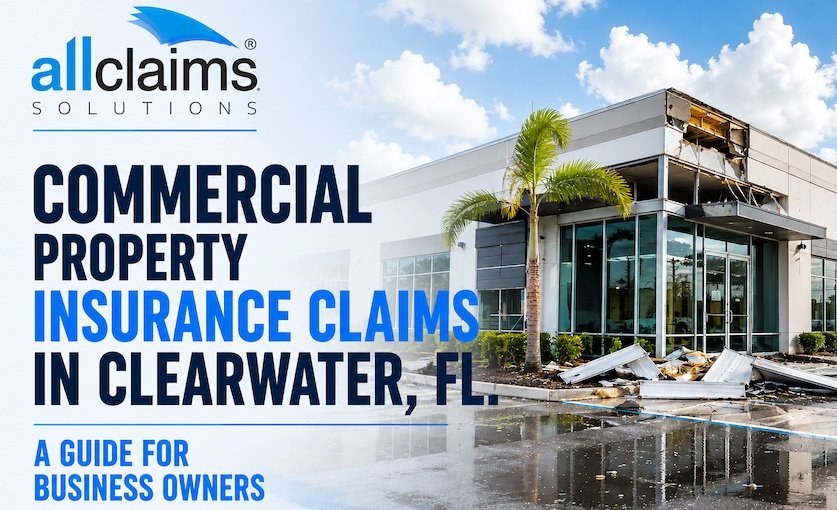
When a business property in Clearwater suffers damage, the financial impact can extend far beyond the cost of repairing the building.
A storm can damage a roof. A plumbing failure can flood an office. A fire can destroy equipment and inventory. Even a relatively small property loss can interrupt normal business operations and create unexpected expenses.
For Clearwater business owners, understanding how commercial property insurance claims work is an important part of protecting the business after a covered loss.
Commercial insurance policies can be more complex than residential policies because they may cover multiple types of property and business-related losses. Depending on the policy, coverage can include the building, business personal property, equipment, inventory, business income, and extra expenses.
At All Claims Solutions, we help Clearwater property owners and businesses navigate the insurance claims process when commercial property has been damaged.
What Is a Commercial Property Insurance Claim?
A commercial property insurance claim is a request for payment or coverage under a business property insurance policy following a covered loss.
Commercial property policies can be structured differently depending on the type of business, property, risks, and coverage selected.
Florida’s Department of Financial Services explains that commercial property coverage can be written through different policy structures, including Commercial Package Policies (CPPs) and Business Owners Policies (BOPs). These policies can contain different coverage forms, causes of loss, deductibles, limits, and endorsements.
Depending on the policy, a commercial property claim may involve:
- Building damage
- Roof damage
- Interior damage
- Electrical systems
- Plumbing systems
- HVAC equipment
- Business personal property
- Furniture
- Equipment
- Inventory
- Computers and electronics
- Property improvements
- Business income
- Extra expenses
This is why commercial claims should be evaluated based on the entire policy and the full scope of the loss, rather than focusing only on the most visible damage.
What Types of Commercial Property Damage Can Be Covered?
The answer depends on the specific policy.
Commercial property policies can differ substantially in their covered causes of loss, exclusions, deductibles, limits, and endorsements.
Common commercial property losses can involve:
Storm Damage
Clearwater businesses can be exposed to wind, severe storms, hurricanes, heavy rain, and other weather-related events.
Storm damage may affect:
- Roofs
- Windows
- Exterior walls
- Interior ceilings
- Electrical systems
- HVAC
- Signage
- Business equipment
- Inventory
👉 Related resource: [Storm Damage Insurance Claims in Clearwater, FL]
Hurricane Damage
Hurricanes can create extensive commercial property losses.
A single hurricane can potentially cause:
Wind damage + roof damage + water intrusion + contents damage + business interruption
Commercial property owners should pay attention to the policy’s specific hurricane provisions, deductibles, exclusions, and coverage limits.
👉 Related resource: [Hurricane Damage Insurance Claims in Clearwater, FL]
Water Damage
Commercial buildings can suffer significant losses from:
- Burst pipes
- Plumbing failures
- Roof leaks
- HVAC leaks
- Sprinkler system failures
- Appliance failures
- Accidental water releases
Water damage can affect both the physical structure and business property inside the building.
👉 Related resource: [Water Damage Insurance Claims in Clearwater, FL]
Fire and Smoke Damage
A commercial fire can result in much more than damage from flames.
The claim may potentially involve:
- Structural damage
- Smoke
- Soot
- Firefighting water
- Electrical damage
- Equipment
- Inventory
- Furniture
- Electronics
- Business records
👉 Related resource: [Fire Damage Insurance Claims in Clearwater, FL]
Roof Damage
Roof problems can create extensive downstream losses for a business.
A damaged commercial roof can lead to:
- Water intrusion
- Ceiling damage
- Interior damage
- Equipment damage
- Inventory losses
- Mold concerns
- Business interruption
A roof claim should therefore be evaluated beyond the visible exterior damage.
Commercial Property Insurance: Building vs. Business Property
One important distinction for business owners is understanding the difference between the building itself and the property used to operate the business.
Depending on the policy, commercial property coverage may address different categories of property.
Building
Potentially covered property may include:
- Roof
- Walls
- Floors
- Ceilings
- Permanent fixtures
- Plumbing
- Electrical systems
- HVAC
- Built-in equipment
Business Personal Property
This can potentially include:
- Furniture
- Computers
- Equipment
- Machinery
- Inventory
- Supplies
- Electronics
- Tools
- Business records
Coverage varies by policy, so business owners should review their declarations, coverage forms, limits, and endorsements.
What Is Business Income Coverage?
One of the most important coverages for a business owner after a major property loss can be business income coverage.
Florida DFS explains that commercial policies can include business income coverage and extra expense coverage. Business income coverage can address reductions in income during a specified period when operations are interrupted by covered property damage, while extra expense coverage can address additional costs incurred to continue operations.
For example, imagine a Clearwater restaurant suffers major fire damage.
The physical property claim might include:
- Building repairs
- Kitchen equipment
- Furniture
- Inventory
- Smoke remediation
But the restaurant could also lose revenue while it is unable to operate.
That creates a potentially separate financial component:
Property damage → Business interruption → Lost income
The exact coverage, limits, waiting periods, and calculation method depend on the policy.
What Is Extra Expense Coverage?
Extra expense coverage can become important when a business incurs additional costs to continue operating after a covered property loss.
Depending on the policy, examples could include expenses associated with:
- Temporary locations
- Equipment rentals
- Emergency services
- Temporary facilities
- Additional operating costs
- Expedited repairs
The purpose is generally to help a business continue operations or reduce the interruption caused by a covered loss, subject to the policy’s terms and limitations.
Commercial Property Claims Can Be More Complicated Than Residential Claims
A residential property claim may primarily focus on repairing or replacing the home and personal belongings.
A commercial claim can involve several interconnected components.
For example:
A Clearwater retail store experiences storm damage.
The storm damages the roof.
↓
Rain enters the building.
↓
Interior walls and flooring are damaged.
↓
Inventory is damaged.
↓
The store must temporarily close.
↓
The business loses revenue.
↓
The business incurs additional expenses.
The claim may therefore involve:
Building + Contents + Inventory + Business Income + Extra Expense
This is one of the reasons commercial property claims require careful documentation and organization.
What Should a Clearwater Business Owner Do After Property Damage?
After a commercial property loss, taking organized steps can help protect both the property and the insurance claim.
1. Prioritize Safety
If the building has structural, electrical, fire, or other hazards, follow instructions from emergency personnel and qualified professionals.
Do not put employees or customers at risk to inspect damaged areas.
2. Document the Damage
Take photographs and videos as soon as it is reasonably safe.
Document:
- Exterior damage
- Roof damage
- Interior damage
- Equipment
- Inventory
- Furniture
- Electronics
- Signs
- Fixtures
- Water intrusion
- Smoke and soot
- Structural damage
Document both the building and business property.
3. Prevent Additional Damage
Florida DFS recommends taking reasonable steps to prevent additional damage, making temporary repairs when necessary, documenting the damage, and keeping receipts. It also recommends making the initial contact with the insurance company yourself when reporting a claim.
Depending on the situation, temporary mitigation could include:
- Covering damaged areas
- Removing standing water
- Securing broken windows
- Protecting inventory
- Boarding openings
- Arranging emergency services
Keep records of what was done and why.
4. Notify Your Insurance Company
Report the loss according to the requirements of your policy.
Florida law currently generally requires a property insurance claim or reopened claim to be reported within one year after the date of loss, while supplemental claims generally have an 18-month reporting period. Certain weather-related losses have specific rules concerning the date of loss.
Because commercial policies and losses can vary, business owners should review their policy requirements and avoid unnecessary delays.
5. Protect Your Business Records
Business records can become extremely important when calculating a commercial insurance claim.
Depending on the claim, useful records may include:
- Sales records
- Tax returns
- Profit-and-loss statements
- Payroll records
- Bank statements
- Inventory records
- Vendor invoices
- Purchase orders
- Business expense records
- Lease documents
- Equipment invoices
These records may help establish the financial impact of the loss.
How to Document a Commercial Property Insurance Claim
A strong commercial claim should tell a clear story:
What happened?
Document the date, event, and circumstances surrounding the loss.
What was damaged?
Document the building, equipment, inventory, furniture, and other affected property.
What will it cost?
Obtain appropriate repair, restoration, replacement, and other estimates.
How did the loss affect the business?
Document business interruption and additional expenses when applicable.
This creates a more complete picture of the claim.
Common Commercial Property Insurance Claim Mistakes
Business owners can unintentionally weaken their position by overlooking important aspects of the loss.
Mistake #1: Focusing only on the building
Commercial claims may include business property and financial losses in addition to structural damage.
Mistake #2: Failing to document inventory
Inventory losses can become difficult to quantify if there are no records.
Mistake #3: Overlooking business interruption
A business may experience financial losses even after the physical damage has been documented.
Mistake #4: Making permanent repairs before documenting the damage
Emergency mitigation may be necessary, but the original condition should be documented whenever reasonably possible.
Mistake #5: Discarding damaged property too quickly
Florida DFS advises policyholders not to discard damaged items without prior approval from the insurance company.
Mistake #6: Assuming the first estimate is the final value of the claim
The insurer’s estimate may not necessarily reflect every component of a complex commercial loss.
Mistake #7: Waiting too long to report the loss
Florida currently has statutory notice deadlines for property insurance claims.
What If the Insurance Company Underpays a Commercial Claim?
A commercial insurance company may acknowledge that damage occurred while disagreeing about the scope or cost of the loss.
Disagreements can involve:
- Roof repairs
- Structural damage
- Equipment
- Inventory
- Building contents
- Code-related work
- Business income
- Extra expenses
- Repair methodology
- Replacement costs
If your Clearwater business receives an estimate that appears incomplete, carefully compare the estimate with the actual documented damage.
👉 Related resource: [Why Insurance Claims Get Underpaid in Clearwater, FL]
What If a Commercial Insurance Claim Is Denied?
A denied commercial property claim can be particularly serious because the financial consequences may extend beyond the physical property.
A dispute may involve:
- Policy exclusions
- Cause of loss
- Coverage limits
- Deductibles
- Documentation
- Property valuation
- Business income calculations
- Scope of damage
If your claim has been denied, review the insurer’s explanation and the relevant policy provisions carefully.
Depending on the circumstances, additional documentation or professional assistance may help you evaluate the available options.
👉 Related resource: [Denied Insurance Claim Help in Clearwater, FL]
Can a Commercial Property Insurance Claim Be Reopened?
Potentially, depending on the circumstances, policy provisions, and applicable Florida law.
Florida’s current property insurance statute defines a reopened claim as a previously closed claim that is reopened upon the insured’s request for additional costs for loss or damage previously disclosed to the insurer. The statute generally establishes a one-year notice period for claims and reopened claims and an 18-month period for supplemental claims.
This can become relevant when:
- Additional damage is discovered
- Repairs reveal hidden damage
- Initial estimates were incomplete
- Additional covered costs arise
- The scope of the loss changes during repairs
Business owners should not assume that closing a claim necessarily means every issue has been resolved.
How a Public Adjuster Can Help With a Commercial Property Claim
A public adjuster represents the policyholder, not the insurance company.
Florida DFS states that public adjusters are licensed professionals who can assist policyholders with claim documentation, filing requirements, and presenting claims to the insurer.
For a complex commercial claim, a public adjuster may assist with:
- Reviewing the insurance policy
- Documenting property damage
- Preparing claim documentation
- Organizing repair estimates
- Documenting business property
- Preparing contents inventories
- Identifying potentially overlooked damage
- Reviewing business interruption documentation
- Communicating with the insurance company
- Presenting the documented claim
- Assisting with disputed or underpaid claims
Commercial claims can involve multiple categories of loss, making organization and documentation particularly important.
Should a Business Hire a Public Adjuster?
There is no single answer for every commercial claim.
Professional claim assistance may be particularly useful when the loss is:
- Large
- Complex
- Multi-category
- Disputed
- Underpaid
- Denied
- Associated with business interruption
- Difficult to document
A business owner should also verify that any public adjuster is properly licensed in Florida. DFS specifically advises consumers to verify a public adjuster’s license and understand the contract before signing.
Commercial Property Insurance Claims for Clearwater Businesses
Clearwater businesses can face many different property risks, including:
- Hurricanes
- Windstorms
- Severe storms
- Fire
- Water damage
- Roof leaks
- Plumbing failures
- Electrical damage
- Equipment losses
Businesses in different industries may also have very different claim profiles.
For example, the property loss of a:
Restaurant
may involve kitchen equipment, food inventory, smoke damage, refrigeration, and business interruption.
A:
Retail store
may have significant inventory and sales-related losses.
An:
Office
may have computers, furniture, technology, records, and loss-of-use concerns.
A:
Warehouse
may have substantial inventory and equipment exposure.
The right claim strategy depends on the specific property, policy, business operations, and circumstances of the loss.
Commercial Property Insurance Claim Checklist
If your Clearwater business has suffered property damage:
☐ Make sure the property is safe
☐ Document the building and contents
☐ Photograph and video all visible damage
☐ Protect the property from additional damage
☐ Keep receipts for emergency expenses
☐ Create an inventory of damaged equipment and property
☐ Document damaged inventory
☐ Preserve damaged items when practical
☐ Notify your insurance company
☐ Obtain relevant repair and restoration estimates
☐ Gather financial records
☐ Document business interruption
☐ Track additional expenses
☐ Keep copies of all insurance correspondence
☐ Review the insurer’s estimate carefully
☐ Consider professional claim assistance for complex or disputed losses
Frequently Asked Questions About Commercial Property Insurance Claims in Clearwater
Coverage varies by policy, but commercial property insurance can potentially cover the building, business personal property, equipment, inventory, and other property identified in the policy. Some policies may also include business income and extra expense coverage.
It may, depending on the policy’s covered causes of loss, exclusions, deductibles, limits, and endorsements.
Some commercial policies include business income coverage. The applicable coverage, limits, waiting periods, and calculation method depend on the policy.
Business income coverage generally addresses certain income losses resulting from an interruption caused by covered property damage, while extra expense coverage can address additional costs associated with continuing operations or reducing the interruption.
Prioritize safety, document the damage, take reasonable steps to prevent further damage, notify your insurer, preserve relevant records, and keep receipts and supporting documentation.
Yes. Coverage disputes can involve the cause of loss, exclusions, policy conditions, documentation, valuation, or other issues.
Depending on the circumstances, a policyholder may have options to dispute an insurer’s determination. Reviewing the denial and policy language carefully is an important first step.
Under current Florida law, a property insurance claim or reopened claim generally must be reported within one year after the date of loss, while a supplemental claim generally must be reported within 18 months, subject to applicable law and policy terms.
A public adjuster may be helpful when a commercial claim is large, complex, disputed, or involves multiple categories of damage and business-related losses. Public adjusters represent policyholders and must be licensed in Florida.
Get Help With a Commercial Property Insurance Claim in Clearwater, FL
A commercial property loss can affect much more than the physical building.
Building damage, equipment, inventory, business property, lost income, and additional expenses can all become important components of a commercial insurance claim.
If your Clearwater business has suffered property damage, All Claims Solutions can help you understand the claims process, document the loss, and present your claim to the insurance company.
Get Your Free Commercial Claim Evaluation
If you’re dealing with a commercial property loss, a denied claim, an underpaid claim, or a complex business interruption issue, contact All Claims Solutions to discuss your situation.
This article is for general informational purposes only and does not constitute legal advice or a determination of insurance coverage. Insurance coverage depends on the specific policy, endorsements, exclusions, deductibles, limits, and circumstances of the loss. Florida insurance laws and requirements may change.